
Every organisation collects data, but relatively few transform it into meaningful action. Sales figures, customer interactions, operational metrics, financial reports, and digital activity generate valuable information every day. Yet without...
Every organisation collects data, but relatively few transform it into meaningful action. Sales figures, customer interactions, operational metrics, financial reports, and digital activity generate valuable information every day. Yet without a structured approach, these datasets often remain isolated across departments, making it difficult to identify trends or understand how one area of the business influences another. Ultimately, turning data into better business decisions is what enables organisations to uncover opportunities, improve performance, and achieve sustainable long-term growth
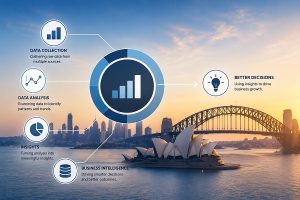
Working with a Data Analytics Agency Sydney is about far more than creating reports or building dashboards. It is about helping organisations turn data into better business decisions by establishing a reliable framework for collecting, integrating, analysing, and interpreting information. As businesses across Sydney continue investing in digital capabilities, analytics has become an essential component of improving performance, identifying opportunities, and managing growth with greater confidence.
Why Better Business Decisions Start with Better Data
Most organisations have access to significant amounts of information. Customer relationship platforms, accounting systems, project management software, marketing tools, and operational applications all contribute to an expanding pool of business data.
The challenge is rarely collecting information—it is understanding what that information is actually revealing.
When departments operate independently, leadership teams often receive multiple reports that measure different outcomes without providing a complete picture of business performance. Marketing may report increasing campaign engagement while finance highlights declining profitability. Operations may demonstrate improved productivity, yet customer retention continues to fall.
Viewed separately, each report appears accurate. Considered together, however, they often expose relationships that would otherwise remain unnoticed.
This is where a Data Analytics Agency Sydney provides measurable value. By integrating information from multiple systems, organisations gain a clearer understanding of how operational activity, financial performance, customer behaviour, and commercial outcomes influence one another, allowing leaders to make better business decisions with greater confidence.
Turning Information into Better Business Decisions
The objective of business intelligence is not simply to produce reports. Its real value lies in helping organisations make faster, more informed, and more consistent business decisions.
Rather than asking what happened last quarter, organisations can begin exploring why performance changed, which factors contributed to those results, and where future opportunities are likely to emerge.
This shift transforms analytics from a reporting function into a strategic business capability.
Leadership teams can evaluate performance with greater context, identify inefficiencies earlier, and prioritise investments based on measurable evidence rather than intuition alone.
As organisations become increasingly data-driven, these capabilities support stronger decision-making across finance, operations, customer experience, sales, and marketing.
Building a Connected Data Environment
Business information rarely exists in one location.
Customer records may be stored within a CRM platform, financial information inside accounting software, operational metrics within ERP systems, and marketing performance across multiple advertising platforms.
Each system contributes valuable information, yet meaningful insights often remain hidden when these datasets are analysed independently.
Creating a connected data environment allows organisations to move beyond isolated reporting towards a broader understanding of business performance.
Instead of reviewing separate departmental reports, executives gain access to integrated information that reveals relationships between revenue, operational efficiency, customer engagement, and commercial performance.
This connected perspective reduces uncertainty, improves collaboration across departments, and provides stronger foundations for strategic planning and informed business decisions.
Data Visualisation That Improves Decision-Making
The value of analytics depends not only on accurate data but also on how effectively information is presented.
Large spreadsheets and lengthy reports frequently make it difficult for decision-makers to identify emerging trends or operational issues quickly. Well-designed dashboards simplify complex information by presenting key performance indicators through clear visual reporting.
Interactive dashboards allow leadership teams to monitor performance in real time, compare historical trends, evaluate business objectives, and identify areas requiring attention without relying on multiple disconnected reports.
Effective data visualisation does more than improve accessibility. It creates greater transparency across the organisation and encourages consistent decision-making based on shared information rather than individual interpretation. When leaders can clearly understand business performance, they can respond faster, prioritise investments more effectively, and make better business decisions.
Predictive Analytics and Strategic Planning
Better business decisions are not based solely on understanding the past. They also depend on anticipating what may happen next.
By combining historical trends with current operational data, businesses can identify patterns that support forecasting, resource planning, customer demand analysis, and financial decision-making. Although predictive models cannot remove uncertainty, they provide a stronger evidence base for evaluating future scenarios and reducing unnecessary risk.
For organisations operating in competitive markets such as Sydney, this capability supports more agile decision-making. Leadership teams can respond to changing market conditions earlier, allocate resources more effectively, and adapt business strategies before challenges begin affecting operational performance.
Rather than reacting to change, businesses are better positioned to anticipate it.
Supporting Digital Transformation Through Analytics
Digital transformation is often associated with new technologies, automation platforms, and cloud infrastructure. While these investments are important, their long-term value depends on an organisation’s ability to understand the information those technologies generate.
Every digital process creates additional data. Without a structured analytics strategy, much of that information remains underutilised.
A Data Analytics Agency Sydney helps organisations establish the processes required to collect, organise, analyse, and interpret data consistently across the business. This creates greater visibility into operational performance while supporting continuous improvement initiatives.
As digital maturity increases, analytics becomes embedded within everyday business activities rather than existing as a standalone reporting function, enabling better business decisions across the organisation.
Data Governance as a Foundation for Reliable Insights
Reliable analytics begins with reliable data.
Incomplete records, inconsistent reporting standards, and disconnected systems reduce confidence in business intelligence and make strategic planning considerably more difficult.
Strong data governance establishes clear standards for data quality, ownership, security, and consistency across the organisation. This ensures that information remains accurate, accessible, and suitable for decision-making at every level of the business.
As organisations continue expanding their digital capabilities, governance becomes increasingly important in maintaining trust in analytical outputs and supporting long-term operational resilience.
Choosing the Right Data Analytics Agency Sydney
Selecting an analytics partner involves more than evaluating technical expertise.
An effective agency should understand how technology, commercial objectives, and organisational processes influence one another. Technical solutions alone rarely deliver meaningful outcomes unless they are aligned with broader business priorities.
Experienced analytics partners typically demonstrate the ability to integrate multiple data sources, design intuitive reporting environments, develop scalable analytical frameworks, and communicate technical findings in a way that supports executive decision-making.
Equally important is their understanding that analytics should improve business capability rather than simply produce more reports, empowering organisations to make smarter decisions every day.
Creating a Culture of Better Business Decisions
Technology provides the tools for analysis, but sustainable improvement depends on how organisations use the insights generated.
Businesses that consistently incorporate data into planning, performance measurement, and operational decision-making develop stronger alignment between departments and create greater confidence in strategic discussions.
Over time, analytics becomes part of organisational culture rather than an isolated technical function. Teams work from a shared understanding of business performance, leadership discussions become increasingly evidence-based, and opportunities for continuous improvement become easier to identify.
This cultural shift enables organisations to move beyond measuring activity and begin making better business decisions with greater clarity, consistency, and confidence.
What does a Data Analytics Agency Sydney do?
A data analytics agency helps businesses collect, integrate, analyse, and visualise information from multiple sources, enabling better operational and strategic decision-making.
How does data analytics improve business performance?
Data analytics identifies trends, measures performance, uncovers operational inefficiencies, and supports evidence-based decisions that improve productivity, customer experience, and commercial outcomes.
Is data analytics suitable for small and medium-sized businesses?
Yes. Organisations of all sizes can benefit from structured analytics. Small and medium-sized businesses often use data analytics to improve reporting, optimise resources, understand customer behaviour, and support future growth.
Why is data governance important?
Data governance ensures business information remains accurate, consistent, secure, and reliable. Strong governance improves confidence in reporting and provides a trustworthy foundation for business intelligence and strategic planning.
Data alone does not improve business performance. The real value comes from transforming information into better business decisions that strengthen strategy, improve operational efficiency, and create measurable commercial outcomes. By combining reliable data, effective analytics, and strong governance, organisations gain the confidence to act on evidence rather than assumptions.
For businesses across Sydney, partnering with a Data Analytics Agency Sydney provides the expertise needed to convert complex information into practical insights. As markets become more competitive and digital transformation accelerates, organisations that consistently make better business decisions through data will be better positioned to adapt, innovate, and achieve sustainable long-term growth.